Why Satellite and Fixed Wireless Internet Often Disappoint
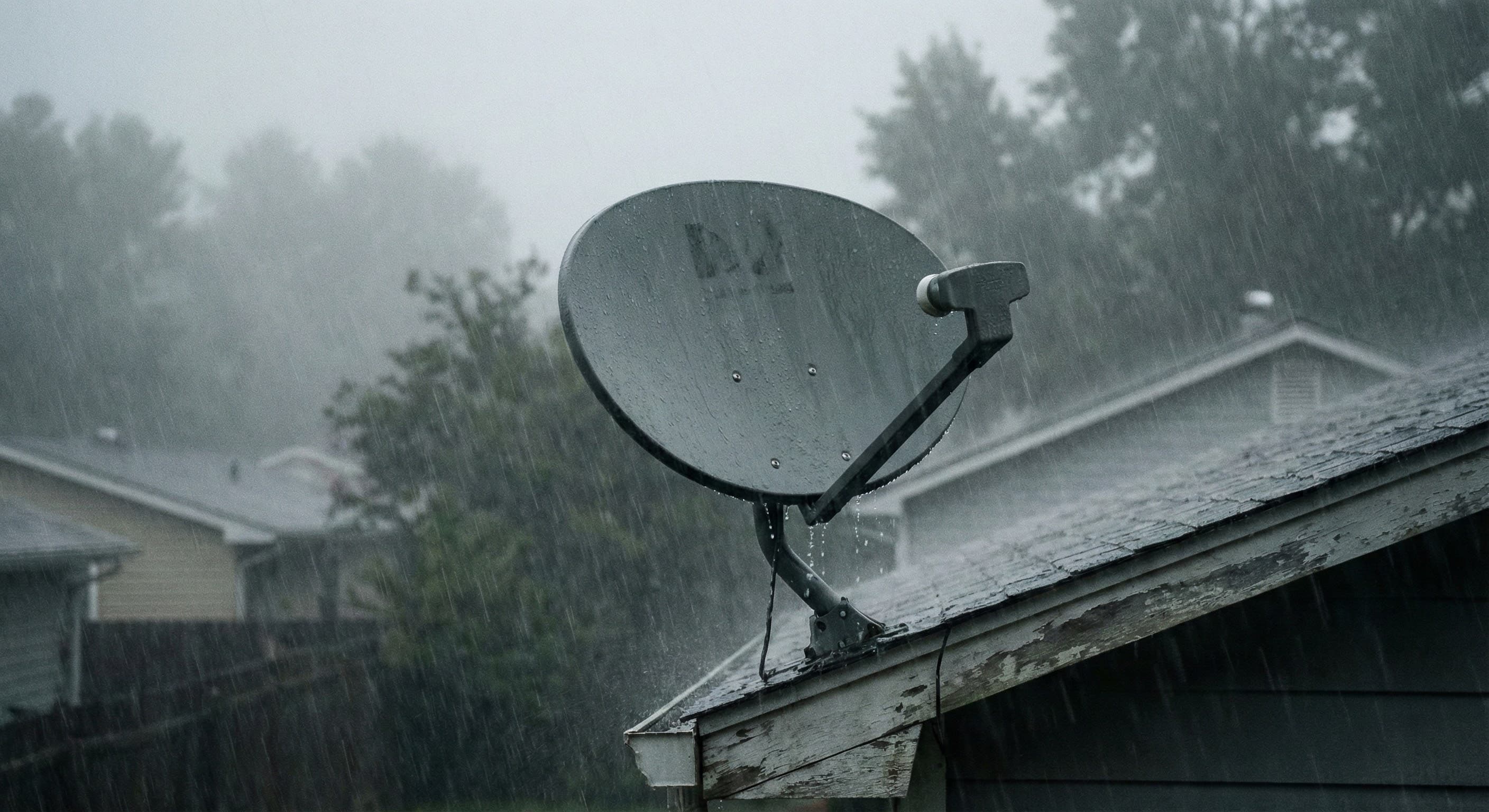
Satellite internet and fixed wireless home internet are marketed as convenient alternatives to traditional wired service. Providers like Starlink, T-Mobile, and Verizon advertise fast speeds and easy setup — no technician visit required.
For some households, these options fill a real gap. But for many others, they underdeliver in ways that aren't obvious until you're already signed up. Here's what the ads don't emphasize — and how to decide whether wireless internet makes sense for your situation.
How Satellite and Fixed Wireless Actually Work
Understanding the technology helps explain the limitations.
Satellite internet transmits data between your home and satellites in orbit. Traditional satellite providers like HughesNet and Viasat use geostationary satellites roughly 22,000 miles above Earth. Starlink uses a constellation of low-Earth orbit (LEO) satellites at around 340 miles, which reduces — but doesn't eliminate — the inherent delays.
Fixed wireless internet — offered by T-Mobile (Home Internet), Verizon (5G Home), and AT&T (Internet Air) — delivers service over cellular networks. A receiver in your home connects to nearby cell towers, essentially using mobile network infrastructure for your home connection.
Neither technology runs a physical wire to your home, which simplifies installation. But that same characteristic introduces the performance tradeoffs.
The Latency Problem
Latency is the time it takes for data to travel between your device and the server you're connecting to. It's measured in milliseconds (ms), and it affects how responsive your connection feels.
Wired connections — fiber and cable — typically deliver latency between 10 and 30 ms. That's fast enough that you don't notice any delay.
Satellite internet is different. Even Starlink's low-Earth orbit satellites introduce latency of 25 to 60 ms under ideal conditions, and it can spike higher during congestion or bad weather. Traditional geostationary satellite services often exceed 600 ms — a delay you'll notice on every click.
Fixed wireless latency varies more. Under good conditions, 5G home internet can approach wired speeds. But latency increases with network congestion, distance from the tower, and signal interference. Real-world performance often lands between 30 and 80 ms, with occasional spikes.
For general browsing and streaming, moderate latency is tolerable. For video calls, online gaming, or any real-time application, it creates noticeable lag.
Speed Inconsistency
Advertised speeds for satellite and fixed wireless can look competitive — Starlink advertises 50–200 Mbps, T-Mobile Home Internet claims 72–245 Mbps, and Verizon 5G Home promises up to 1 Gbps in some areas.
But advertised speeds and actual speeds often diverge.
Satellite speeds fluctuate based on weather conditions, network congestion, and how many users share your satellite beam. Starlink speeds have decreased in some areas as the service has grown more popular, and rain or heavy cloud cover can temporarily degrade performance.
Fixed wireless speeds depend on your cell signal. If you're close to a tower with strong 5G coverage, performance can be solid. If you're farther away, relying on 4G LTE, or in an area with heavy network usage, speeds drop — sometimes significantly. The same household can experience fast speeds at 2 a.m. and sluggish speeds at 7 p.m.
With cable or fiber, you're more likely to get the speed you're paying for, consistently.
Data Caps and Throttling
Some satellite and fixed wireless plans include data caps or deprioritization policies that can limit your usage.
HughesNet and Viasat both impose data caps on most plans, after which speeds are reduced dramatically. Starlink has introduced "priority" and "standard" data tiers, with slower speeds once you exceed priority data during peak hours.
T-Mobile and Verizon's fixed wireless services don't have hard data caps for most plans, but both reserve the right to deprioritize home internet customers behind mobile users during congestion. In practice, this means your speeds may slow when the network is busy — which often coincides with when you most want to use it.
Fiber and cable plans rarely have meaningful data caps, and deprioritization isn't a factor.
Reliability and Weather
Wired internet isn't affected by weather under normal conditions. Satellite internet is.
Rain, snow, and heavy cloud cover can interrupt satellite signals — a phenomenon called "rain fade." Starlink's low-orbit design makes it less susceptible than traditional satellite, but it's not immune. Users in areas with frequent storms report intermittent outages.
Fixed wireless is less weather-sensitive, but it's still affected by signal interference, tower outages, and network congestion. Because you're sharing capacity with mobile users in your area, service quality depends partly on factors outside your control.
When Satellite or Fixed Wireless Makes Sense
These technologies exist for a reason. They make sense when:
- Fiber and cable aren't available at your address
- You need internet service quickly and can't wait for a wired installation
- You're in a rural area where satellite is the only option with reasonable speeds
If you're in a location where wired service simply isn't offered, Starlink or fixed wireless may be the best available choice — and for rural users, Starlink in particular has been a meaningful improvement over legacy satellite options.
But if fiber or cable is available, those connections will typically deliver faster, more consistent, more reliable service.
How to Know What's Available
Before signing up for satellite or fixed wireless, it's worth checking whether wired options exist at your address. Fiber availability has expanded significantly in recent years, and you may have access to options that weren't available when you last checked.
Compare plans with RateMapper
See what you could be saving
RateMapper shows you every internet plan available at your address — with real pricing, features, and speeds. Best of all, it's totally free.
If you're comparing fiber vs. cable internet, either will generally outperform wireless alternatives for most households.
The Bottom Line
Satellite and fixed wireless internet can fill gaps where wired service isn't available. But they come with real limitations: higher latency, inconsistent speeds, potential data restrictions, and weather sensitivity.
If fiber or cable is available at your address, those wired options are almost always the better choice. And if you're stuck with wireless, knowing the tradeoffs helps you set realistic expectations — and shop for the best available plan.